
Blog
DNS Security Best Practices
DNS security best practices — DNSSEC, DNS over HTTPS, local DNS protection and restricted access — help you safeguard your network from spoofing, cache poisoning and interception, keeping your DNS infrastructure secure and reliable.
Jan 15, 2026 · NoFlare Team
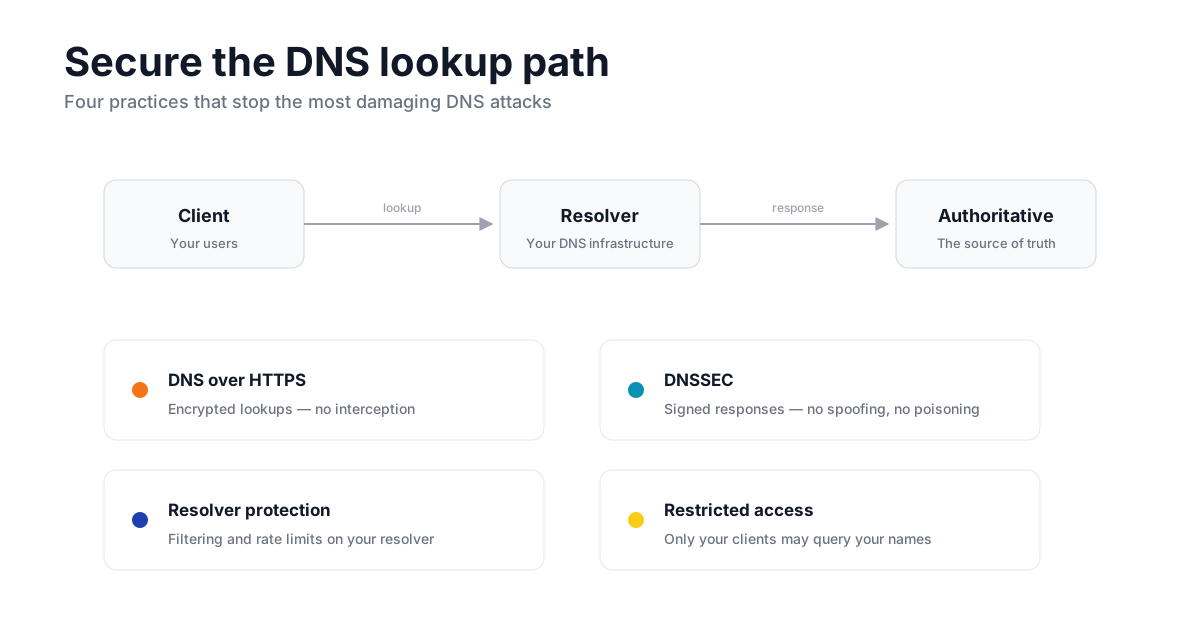
DNS is a quiet dependency: most of what your customers do starts with a name lookup, which is exactly why attacks on it are so damaging. A few well-established practices go a long way to keeping your DNS infrastructure secure and reliable.
The reason DNS deserves attention is that it sits underneath everything else. Customers do not notice DNS working — they only notice it when it is compromised, and by then the damage is often already done: traffic redirected, customers intercepted, and a recovery that takes longer than any DDoS outage because trust in the names themselves has to be rebuilt. The practices below are the ones that reliably prevent the most common and the most damaging DNS attacks.
Why DNS security is a business issue
A compromised DNS zone does not just break your website — it redirects your customers. Spoofed answers can send a banking customer's traffic to an attacker's server, a cache-poisoned resolver can serve the wrong destination to thousands of clients at once, and a hijacked zone can cut off access to your entire online presence.
The economics are unforgiving. DNS incidents are hard to detect, hard to explain to customers, and slow to unwind because caches propagate lies as widely as they propagate answers. Investing in the four practices below is materially cheaper than a single serious incident, and each one removes a whole class of attack.
Verify responses with DNSSEC
DNSSEC lets resolvers confirm that a DNS response is authentic. Enabling it stops the two most common DNS attacks — spoofing and cache poisoning — from succeeding, so the data your network trusts is the data your domain actually publishes.
From the business perspective, DNSSEC converts "we trust what the resolver says" into "we trust what the resolver proved." When a customer's resolver verifies your zone's signatures, a spoofed response is rejected at the moment it arrives — before it can redirect traffic or poison a cache. For organizations handling payments, personal data or any customer-facing service, that verification is the difference between a redirect that is mathematically impossible and one that is only statistically unlikely.
Encrypt queries with DNS over HTTPS
Plain DNS traffic is readable on the wire. DNS over HTTPS (DoH) encrypts queries, protecting the privacy of what your users look up and preventing interception or manipulation by intermediaries.
This matters in two directions. On the privacy side, encrypted queries mean that intermediaries on the path — carriers, Wi-Fi providers, compromised network equipment — cannot see which domains your users are reaching. On the security side, encryption closes the window where an attacker on the path could tamper with responses in transit. For organizations whose customers use public or semi-public networks, DoH is the baseline control that keeps name resolution trustworthy outside your own perimeter.
Protect your internal DNS servers
Your authoritative and internal resolvers are high-value targets. Restrict access to them, monitor for unauthorized queries, and segment them from untrusted networks so an internal breach cannot pivot into your DNS infrastructure.
Attackers know that DNS is the soft underbelly of most networks: a single compromised internal resolver can be used to redirect traffic for the entire organization, exfiltrate data through DNS, or establish persistence that survives password resets. The controls are well understood — access lists, segmentation, logging and alerting on anomalous query patterns — but they only work when they are enforced consistently. A resolver that is "mostly restricted" is a resolver an attacker can eventually reach.
Restrict unwanted DNS access
Block the DNS queries you do not need. Tightening which clients can query your infrastructure reduces the surface area an attacker can probe and keeps your DNS operations focused on legitimate traffic.
Every open DNS endpoint is an information leak: zone transfers reveal your infrastructure, verbose responses reveal internal naming, and unneeded query sources are a path for amplification attacks that use your servers to attack someone else. Restricting access to the clients that actually need it is one of the highest-value-per-effort controls in DNS security — it shrinks the attack surface, improves response quality and simplifies the logging you rely on for incident response.
Put the practices in place
These controls work best together: DNSSEC for authenticity, DoH for privacy, local protection for your resolvers, and access restriction for everything else. NoFlare's DNS Protection service implements all of them, so you can harden your DNS infrastructure without building the controls from scratch.
If you are not sure where your DNS infrastructure stands, the fastest way to find out is a review of your zone setup, resolver exposure and query paths. Talk to our team and we will help you close the gaps — before an attacker does.